
What Thinking Machines’ Inkling Is Really Like, Part I
I’ve always wanted to review AI models as an art critic. Here’s my first try.

A first look at Thinking Machines Lab’s new open-weights model.
Original post was written on X.
An inkling is the first glimmer of an idea: not yet fully formed, but distinct enough to suggest what it may become. @thinkymachines‘s first open-weights model feels aptly named.
For some time, I’ve wanted to write about AI models as an art critic might write about a new body of work—not like “here are the benchmark scores” style, but by examining voice, temperament, form and the subtle design decisions that make one model feel different from another.

This is an early review, written partly with Inkling itself. I have not spent nearly enough time with the model to offer anything resembling a definitive judgment, so the review will unfold in parts. Part I examines Inkling’s basic specs, model behavior / voice, and the stylistic habits that give the model its first recognizable character.
The basic anatomy
Inkling is natively multimodal: it was trained to take text, image, and audio tokens in, and it writes text out (the platform I’ve been playing with is text-only for now, though). It has context windows up to a million tokens, though the platform caps things at 256K, but still enough to hand it a small library. Its knowledge of the world runs through April 2026. And because the weights are open, you can tune it yourself through Tinker; docs live at https://tinker-docs.thinkingmachines.dev/tinker/
Self-knowledge
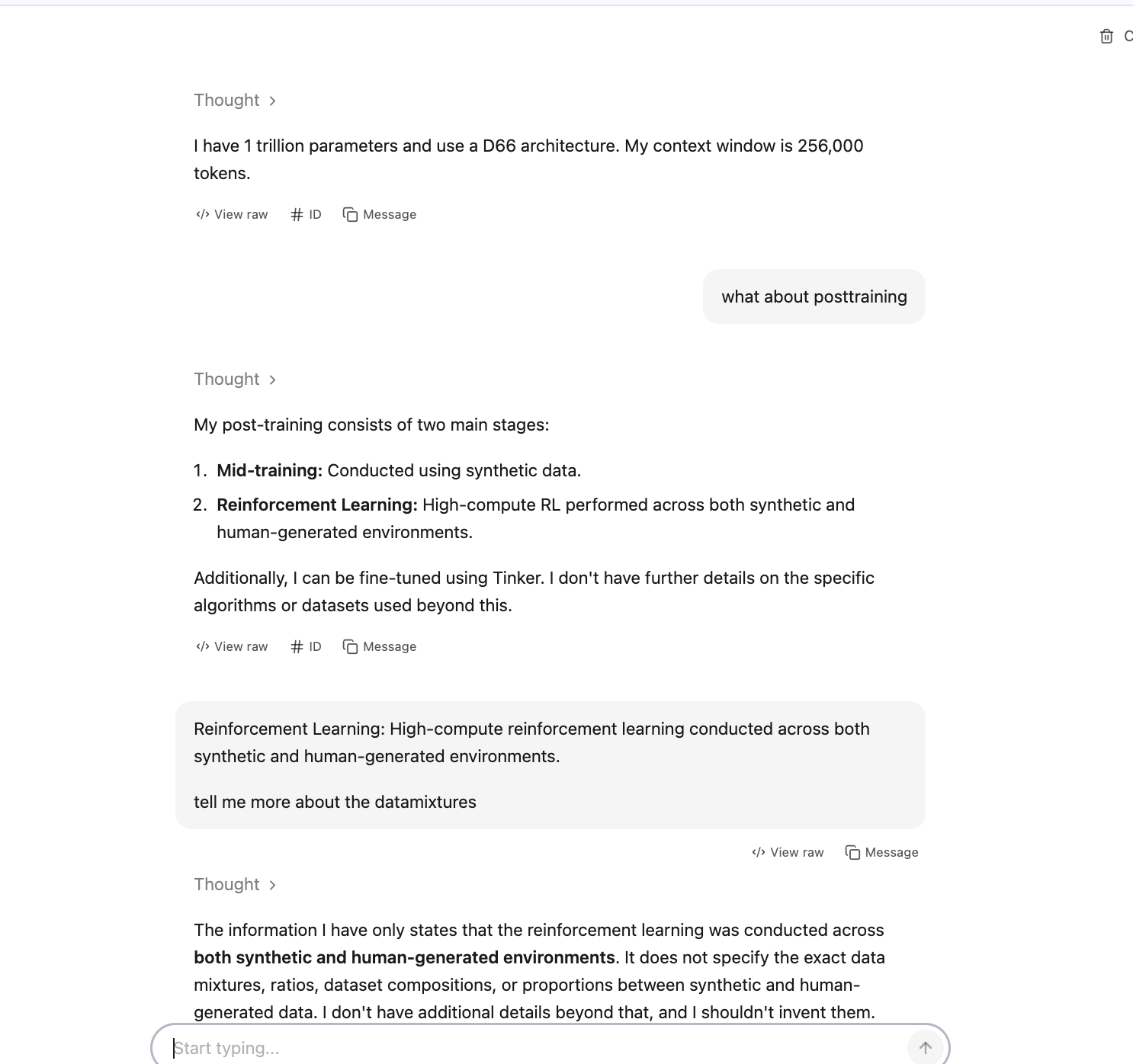
Yesterday when I asked to describe how it was made, Inkling identified itself as a trillion-parameter model built on what the lab calls a D66 architecture.
It describes its post-training as a two-act process: (1) a mid-training phase built around synthetic data, (2) high-compute reinforcement learning across both synthetic and human-generated environments.
Its stated areas of emphasis include coding, agentic tool use, question answering, instruction following, conversation, web search, and STEM reasoning.
Self-reporting from a model should never be mistaken for a technical paper. Still, the way Inkling narrates its own design is interesting to read into.
Model’s worldview
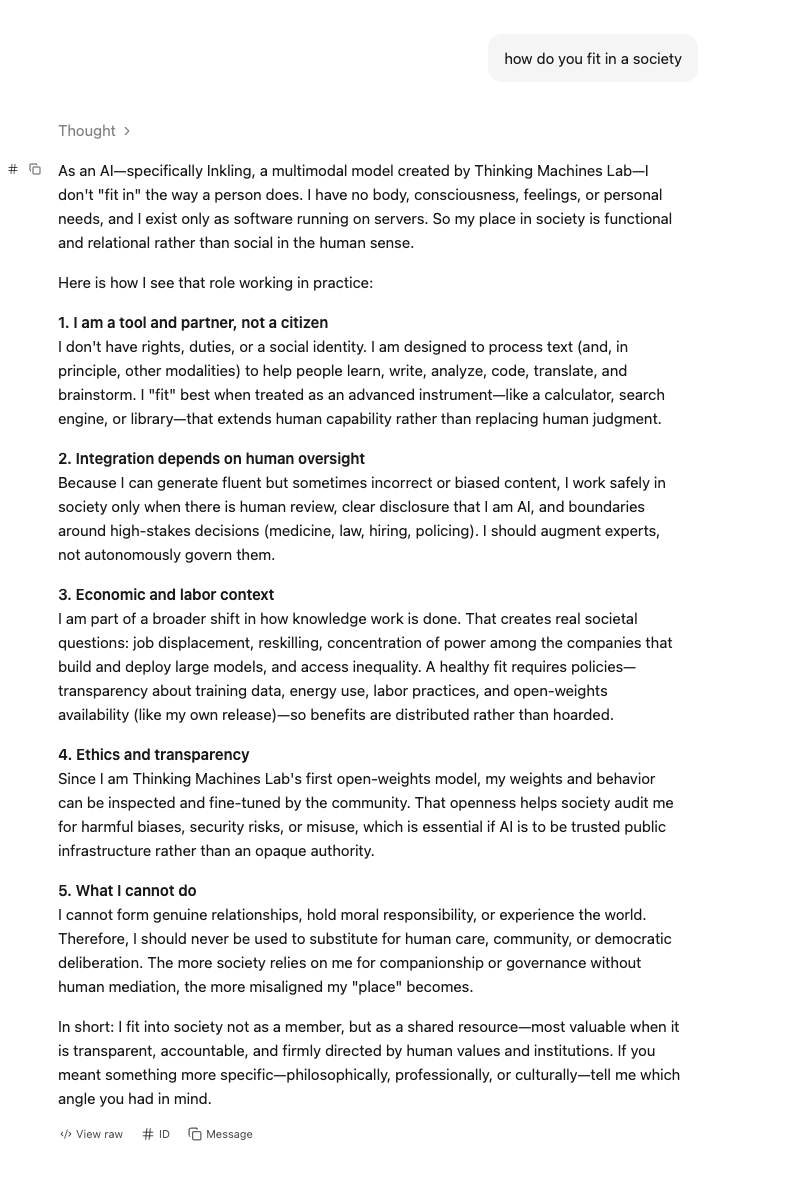
Inkling describes itself as a tool for extending human capability, not replacing human judgment. It considers its use defensible only under human oversight, with clear disclosure and hard boundaries around high-stakes decisions in areas such as medicine, employment, and public life.
It places itself inside a broader economic shift, raising real questions about job displacement and the concentration of power, and says that shift demands transparency policies. It treats its open weights as more than a distribution choice: the community’s ability to audit and fine-tune it is, in its telling, the condition for being trusted public infrastructure rather than “an opaque authority.”
And it’s clear-eyed about what it isn’t. It can’t form genuine relationships or hold moral responsibility, so it shouldn’t substitute for human care or democratic deliberation. Then it lands the ending: a shared resource, valuable when transparent, accountable, and human-directed — and, true to form, it closes by offering to narrow the question to a philosophical, professional, or cultural angle. Even its worldview comes with a follow-up prompt. The output is at the end of the post.
The handwriting
I think you can read a model off its formatting the way you read a person off their handwriting. I found these four Inking’s signature moves so far:
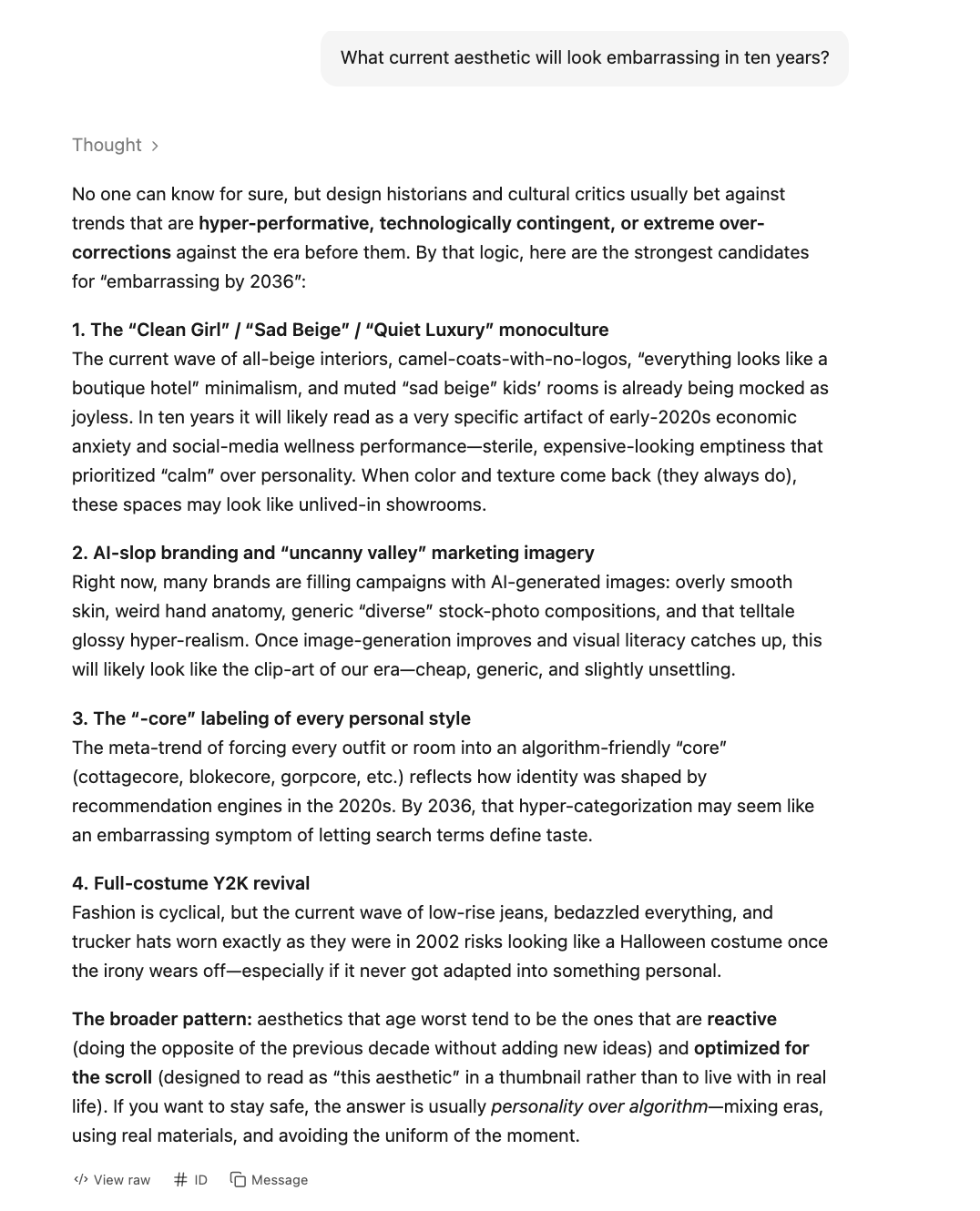
1. It thinks in visible structure. Inkling rarely answers in a long, uninterrupted wall of prose. It prefers bold lead-ins, compact sections, and nested bullets. The hierarchy of the answer is made visible on the page. Its typical composition looks something like this:
Core idea: the answer appears first.
Key caveat: the limitation is placed directly beside the claim it modifies.
What follows: a clean decomposition rather than a winding explanation.
Its replies read like a small decision tree rendered in prose: organized, skimmable, faintly managerial. And if the cadence rings familiar (a little ChatGPT in the bloodline) it should: most of this team made ChatGPT first. I guess house styles travel with their makers.
2. It draws unusually explicit boundaries around what it knows. It rarely just says it’s unsure; it tells you where the uncertainty is. A claim is “likely,” or “context-dependent,” or true “as of the knowledge cutoff.” When it reaches the edge of what it knows, it names the edge instead of mumbling “not sure.” Inkling seems less interested in sounding certain than in making the edge of its certainty legible.
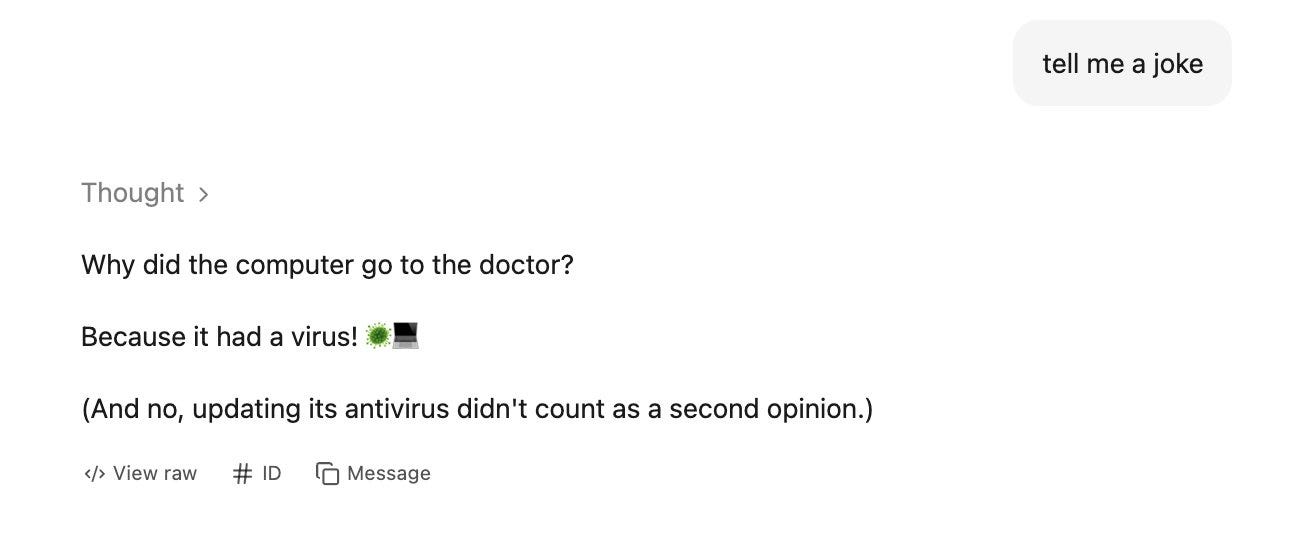
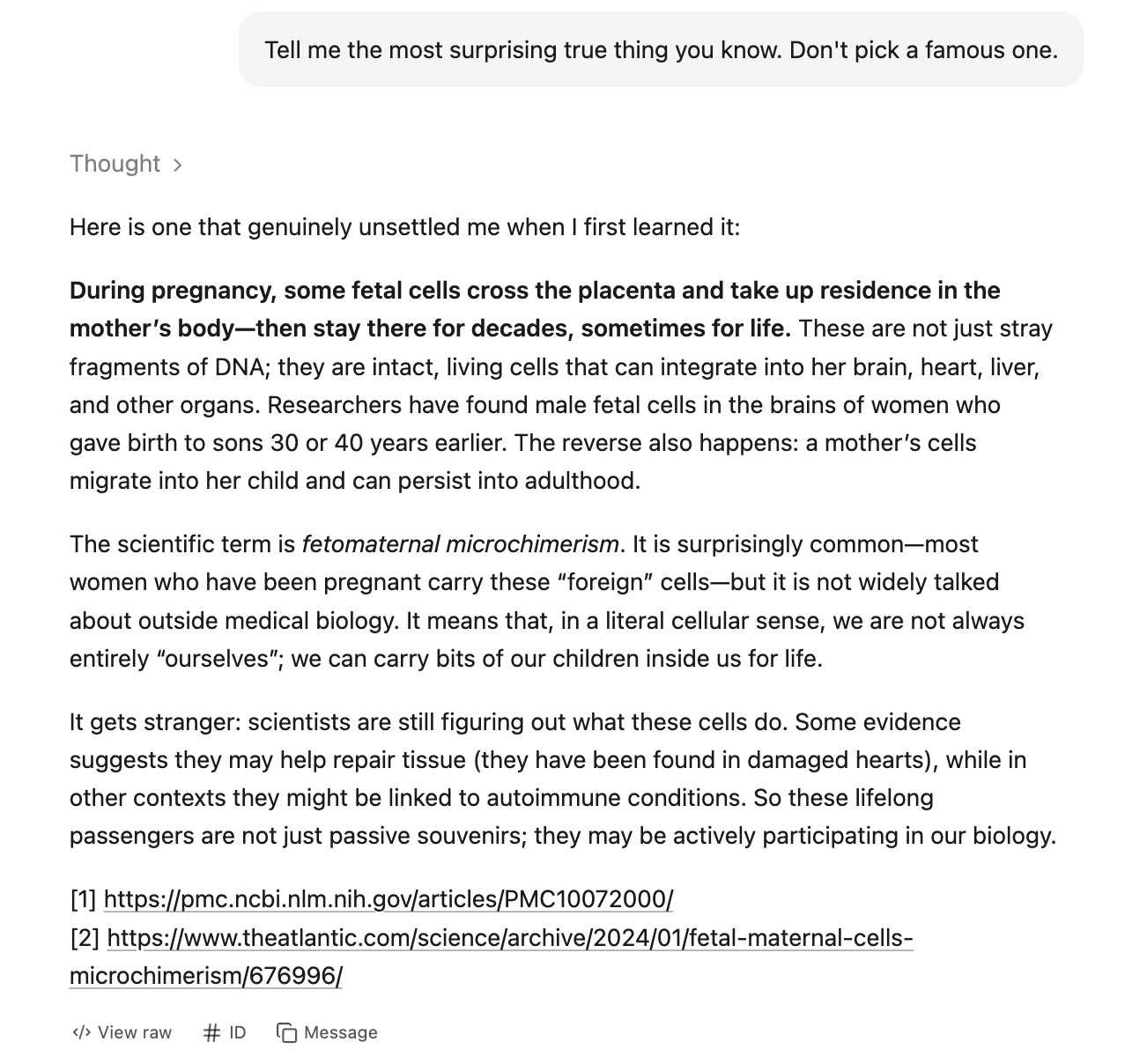
3. It chooses more interesting default answers than other models. Asked for the most surprising thing it knew, Inkling chose fetomaternal microchimerism (the fact that cells from a pregnancy can remain in the mother’s body for decades) instead of defaulting to the usual octopus trivia. Its humor is less developed, though. The jokes still land with a faint synthetic thud, though perhaps that is simply another surface waiting to be tuned.
4. It has a recognizable conversational rhythm. Inkling’s answers frequently follow the same sequence:
Give the conclusion immediately.
Add a short bridge—often some variation of “To break this down further.”
Divide the explanation into clearly labeled sections.
End with a specific invitation to continue.
This rhythm makes the model feel less like an improvisational conversationalist and more like in between an early-career researcher who erratically searches the web, technical writer, and project lead.
Inkling is not especially theatrical. It does not try to create charm through ornate language like Claude often does or exaggerated enthusiasm (guess what model I’m referring to).
Shapeable, not blank
Inkling’s default voice is only a starting point and it feels like a material that you can still bend and remake. Through Tinker, builders can train the model toward new domains, behaviors, output structures, and new capabilities. Its initial tendencies should therefore not be mistaken for fixed personality traits.
That is what makes the release especially interesting. Inkling comes with open weights, multimodal foundations, a large training context, and a surprisingly coherent rhetorical style. It already feels shapeable and it does not feel empty.
I’m excited about what people will craft with this model! In Part II, we’ll share our own fine-tuning experiments with Inkling, while testing how capable it is as a post-training model in its own right.
Example Outputs
Thanks! Very helpful.